The Problem
Retail clients kept walking into the same wall: their digital experience could personalize, react, and iterate in real time — but the physical store couldn't. Merchandising was fixed until someone manually changed it. A product could be trending online right now and the shelf wouldn't know for days. The store was the one channel standing still while every other channel around it had gone dynamic.
I led creative direction and design strategy for the team at Valtech's Future Studio tasked with answering a blunt question we kept getting from retail clients: if the app can be this responsive, why can't the store? That became Dynamic Store — a concept built to prove a physical retail environment could adapt the same way a well-built digital product does.
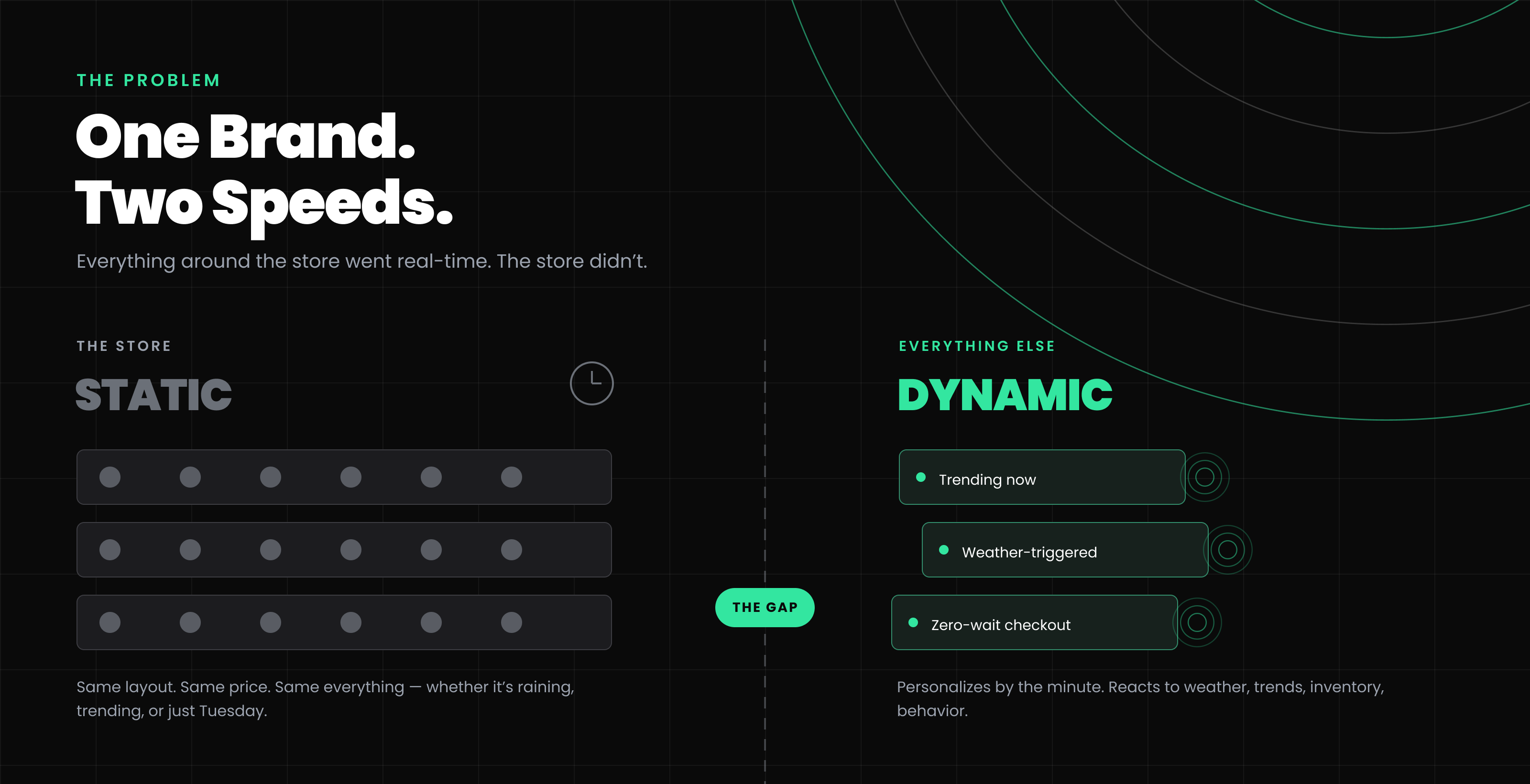
The core tension: every other channel had gone real-time and reactive — the store hadn't. That gap is what Dynamic Store was built to close.
Research & Discovery
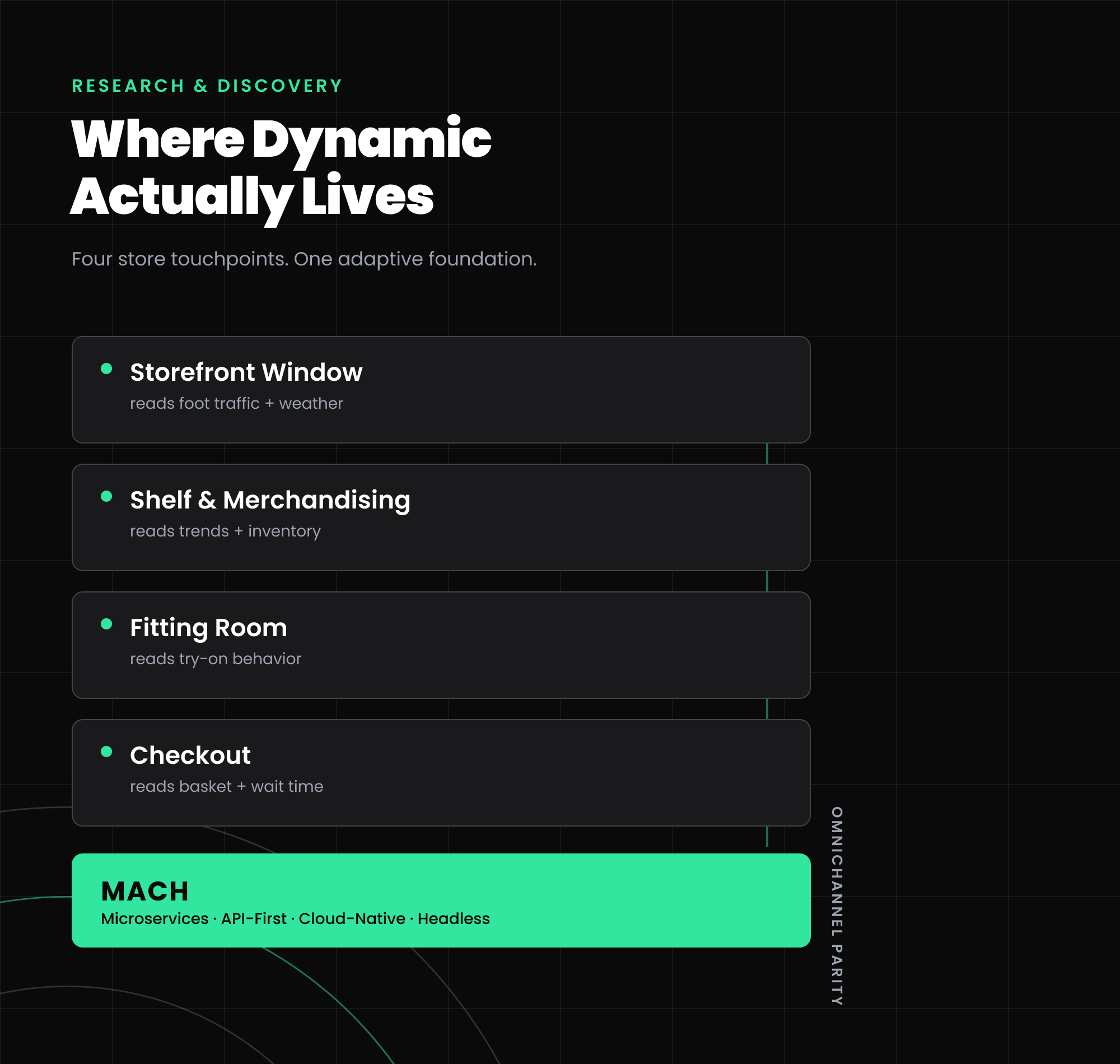
We grounded the concept in where composable commerce architecture was heading — MACH (Microservices, API-first, Cloud-native, Headless) — because the creative vision only worked if the underlying systems could actually support it. I worked with our strategy and engineering leads to map which "dynamic" moments were technically real versus theatrical, using examples like MAC Cosmetics' AR Virtual Try-On as proof that headless, composable architecture could ship experiences like this at production speed, not just in a lab.
From there we benchmarked what "adaptive" could mean at every layer of a store: the shelf, the fitting room, the checkout line, the storefront window. The thread that tied it together was omnichannel parity — the store needed to feel like it belonged to the same brand as the app, not a separate, slower experience bolted on next to it.
Design Process
As team lead, my job was to keep a small, maker-driven group — strategists, experience designers, and engineers — moving as one unit instead of handing off in sequence. I set the creative direction for three signature moments we'd use to make "dynamic" tangible rather than abstract: merchandising that reacts to real-world relevance (a product trending because of a celebrity sighting gets surfaced immediately), displays that respond to forecasted weather, and a checkout experience with the friction engineered out entirely.
I pushed the team to prototype these as an experiential walkthrough rather than a deck — something a client could physically move through at a Future Studio session and feel the shift, not just hear about it. That decision shaped everything downstream: every concept had to survive being demoed live, in real time, in front of a retail client.
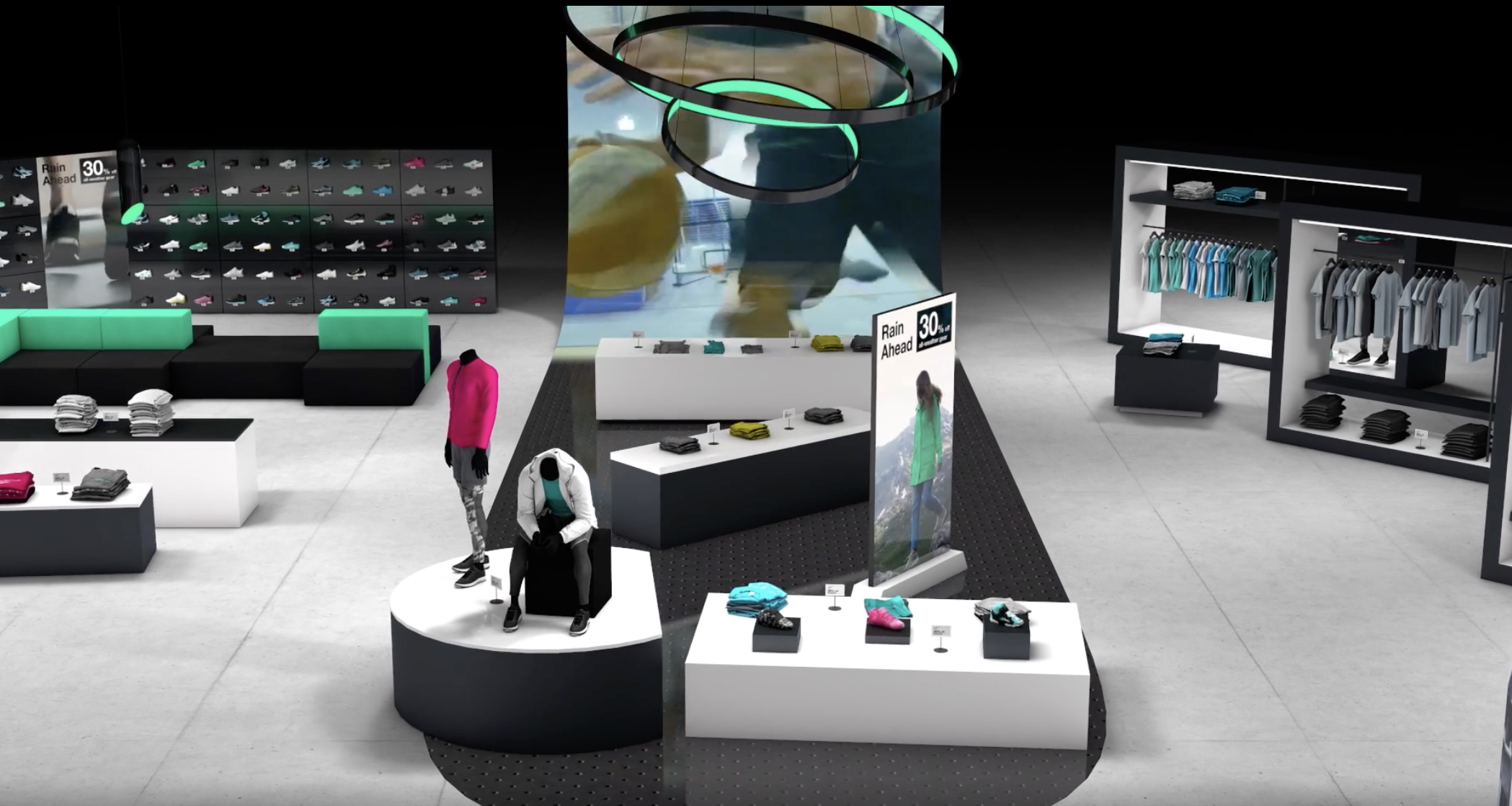
A render from the Dynamic Store concept: weather data triggers the "Rain Ahead — 30% off all-weather gear" signage and pulls the relevant apparel forward, in real time, without a single fixture moving by hand
The Concept in Motion
Static renders could show the "what." Only a walkthrough could show the "why it matters" — the store noticing, deciding, and changing itself while a shopper is still standing in it. This is the actual demo film we built and used with clients at Future Studio.
Key Design Decision
That was a deliberate creative-strategy bet, not a technical one. A store concept confined to a single physical showroom only reaches whoever can travel there. Directing the team to build a parallel virtual experience meant Dynamic Store could keep doing its job — making an abstract "adaptive retail" pitch feel concrete — for any client, anywhere, long after the initial walkthrough ended.
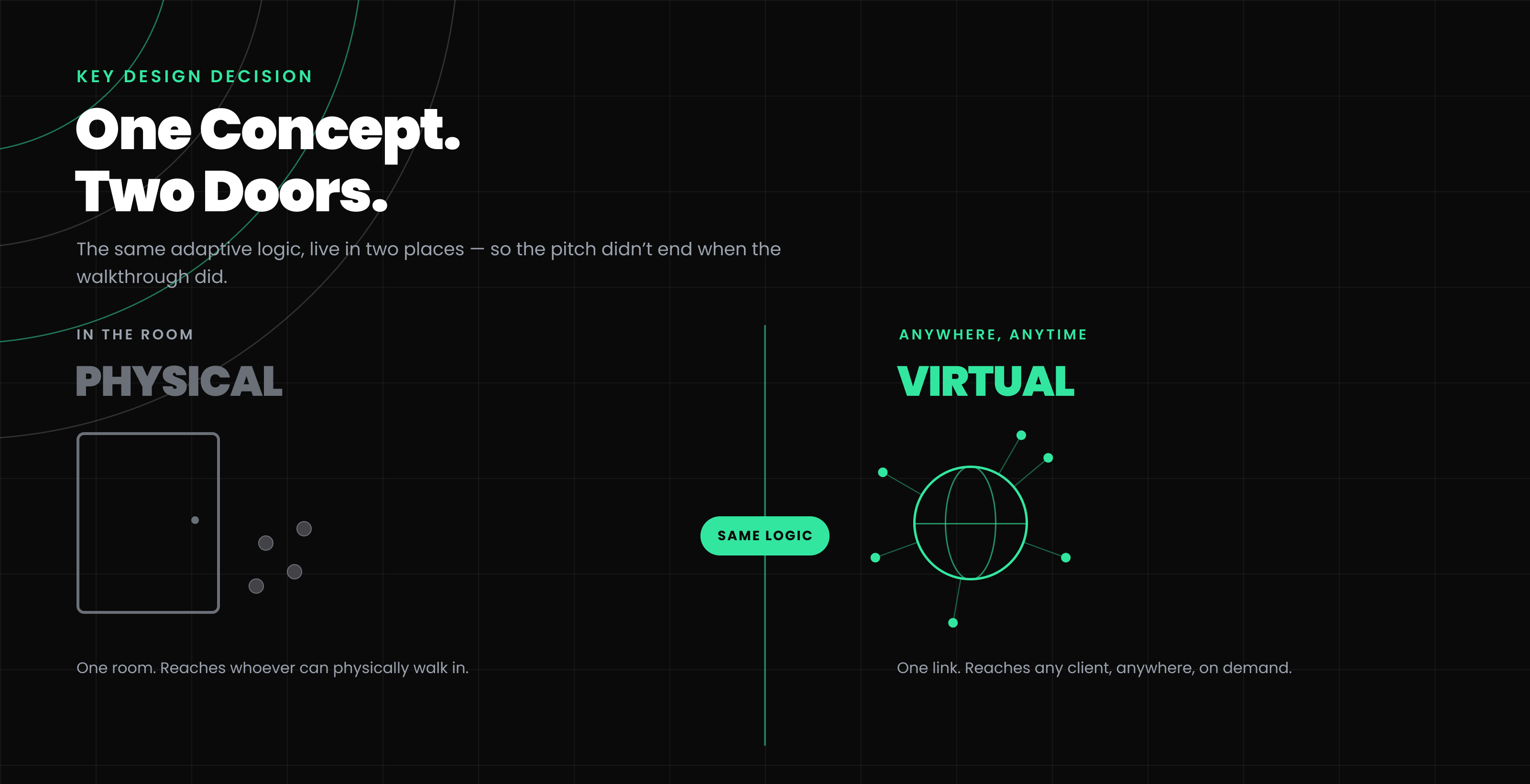
The same adaptive logic, running in two places at once — a physical showroom reachable by whoever's in the room, and a virtual companion reachable by anyone, anywhere
Outcomes
Dynamic Store became one of the concepts Valtech used to move retail clients from "we know we need to modernize" to a concrete, walkable point of view on what modernized actually looks like — and it fed directly into the broader Dynamic Spaces and retail innovation work Future Studio built out afterward.