The Problem
Samsung's BESPOKE appliance line — a fully modular, 11-color-customizable premium refrigerator system starting at $3,099 — had a fundamental retail problem. On the showroom floor, it sat next to an $849 French-door model that looked nearly identical. The premium value proposition — personal customization, connected ecosystem, kitchen-native design — was invisible without context. Customers couldn't visualize how a 36" wide, 70" tall appliance would look or fit in their own kitchen, and they couldn't see their color choice rendered against their actual cabinetry. The result: 73% of shoppers who visited a Samsung display left without purchasing and never returned to that retailer for that category.
The brief: build an immersive in-store experience that brings the customer's kitchen to the store. Not a product demo, not a spec sheet on a screen — a tool that eliminates the three conversion blockers (spatial fit, color preview, ecosystem clarity) in a single, guided interaction. Our team worked across UX, visual design, and interaction prototyping to design the Connected Home AR showroom and the BESPOKE Design Studio configurator.
A $3,099 BESPOKE refrigerator and an $849 standard model look nearly identical on the showroom floor — the premium value lives in personalization and context that in-store retail can't convey
Research & Discovery
We partnered with a retail research team to run both qualitative and quantitative studies — in-store intercept interviews at Samsung Experience Stores, shopper journey mapping, and a 180-person concept validation study. My role was to work alongside research on the study design, sit in on interviews, and translate findings into design direction quickly enough to influence the product brief.
Three barriers accounted for nearly all deferred purchase decisions. First: spatial anxiety — customers couldn't picture a large appliance fitting in their kitchen without standing measurements in hand. Second: color confidence — BESPOKE's core value is the 11-panel color system, but in-store displays showed 1–2 configurations under retail lighting that bore no resemblance to a customer's kitchen. Third: ecosystem value — Samsung's SmartThings integration is a meaningful differentiator, but only visible if customers can see their whole kitchen working together at once.
Four research findings that shaped every design decision: 73% dropout rate, spatial anxiety as the #1 barrier, zero in-store color preview, and 40% willingness to pay more with visualization confidence
Design Process
Our team designed two complementary surfaces that work together: the BESPOKE Design Studio (a guided 3-step configurator) and the Connected Home AR experience (a tablet-based tool for life-scale appliance visualization). The configurator handled personalization — model selection, panel color customization, real-time 3D kitchen rendering. The AR experience handled spatial proof — the configured appliance placed at 1:1 scale through the device camera, with Move, Rotate, and Scale controls designed for retail associates and customers alike.
We prototyped and tested 6 rounds across Samsung Experience Store locations, iterating on the handoff between configurator and AR view. The critical insight from testing: customers who completed the configuration step first converted at 3× the rate of those who went straight to AR. Intent precedes proof — the guided flow had to come before the camera opened. We also designed for the sales associate as a secondary user: the AR view needed to work as a demo tool, not just a self-service feature.
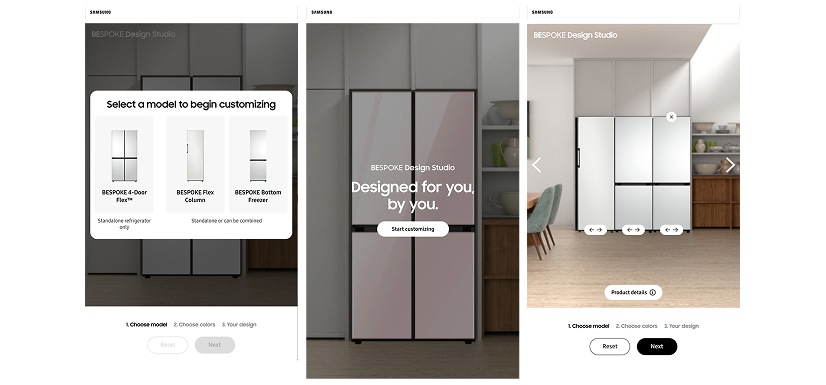
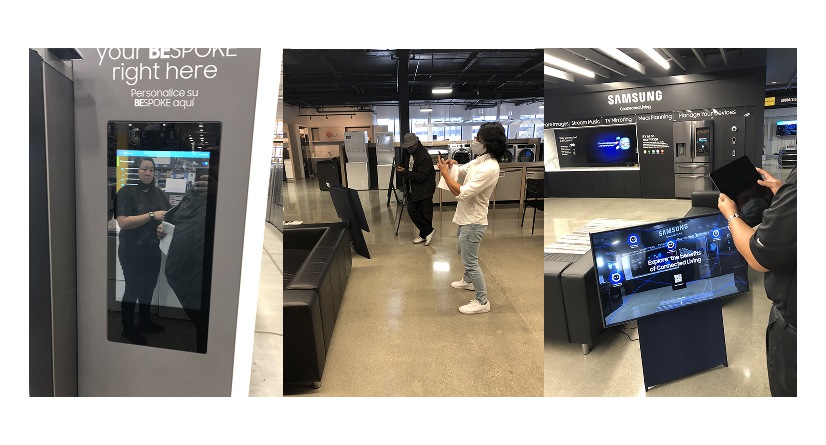
Left: The BESPOKE Design Studio — 3 steps from model selection to photorealistic kitchen rendering with 11 panel color options. Right: In-store deployment at Samsung Experience Store — vertical kiosk touchscreens and associate-led tablet AR demos
Key Design Decision
The central tension in the design was open AR versus guided configuration. The original brief called for a free-exploration AR tool — place any Samsung appliance anywhere in view, explore the ecosystem. In early testing, this failed entirely. Customers opened the AR camera and froze. Without a purchase narrative, AR became the product instead of a bridge to a decision. Sales associates abandoned it within two minutes of the start of a demo.
- ✕No narrative — customers placed items randomly with no purchase intent context
- ✕Free exploration = cognitive overload. Sales associates abandoned the demo after 2 minutes
- ✕No connection between AR view and product configuration — color choices existed in a separate flow
- ✕AR became the product instead of a bridge to the purchase decision
Freestyle AR (rejected): cognitive overload, no narrative, abandoned in testing. Guided configurator (shipped): 3-step journey builds intent before AR opens — AR becomes the proof, not the entry point
Final Design
The shipped experience: a Samsung tablet running the Connected Home AR showroom, deployed across Samsung Experience Store locations and select retail partner sites. Customers and associates start with the BESPOKE Design Studio — choose your model, choose your panel colors, see your configuration rendered in a photorealistic kitchen. Then they open AR and place their configured appliance at life-scale in the store environment, with the SmartThings AI Energy Saver layer surfacing real-time ecosystem context as connected appliances are added. The "Designed for you, by you" narrative carried through from the first tap to the final placement — spatial confidence at every step.
The Connected Home AR showroom: refrigerator, TV, and washer placed at life-scale with Move/Rotate/Scale controls, SmartThings AI Energy Saver active — the full ecosystem visible in one view for the first time
Outcomes
The BESPOKE Design Studio and Connected Home AR experience proved a principle that applies beyond retail: spatial anxiety is a design problem, not a customer problem. When customers could see their exact color choice rendered in a kitchen at life-scale — before they ever opened the AR camera — the purchase decision resolved itself. Our team brought the customer's kitchen to the store, and the store finally had a reason for premium to justify its price.